ARTICLE DRAWING / CMS DETAIL
Published in Career Advice

Courtney
The Effective Project Manager
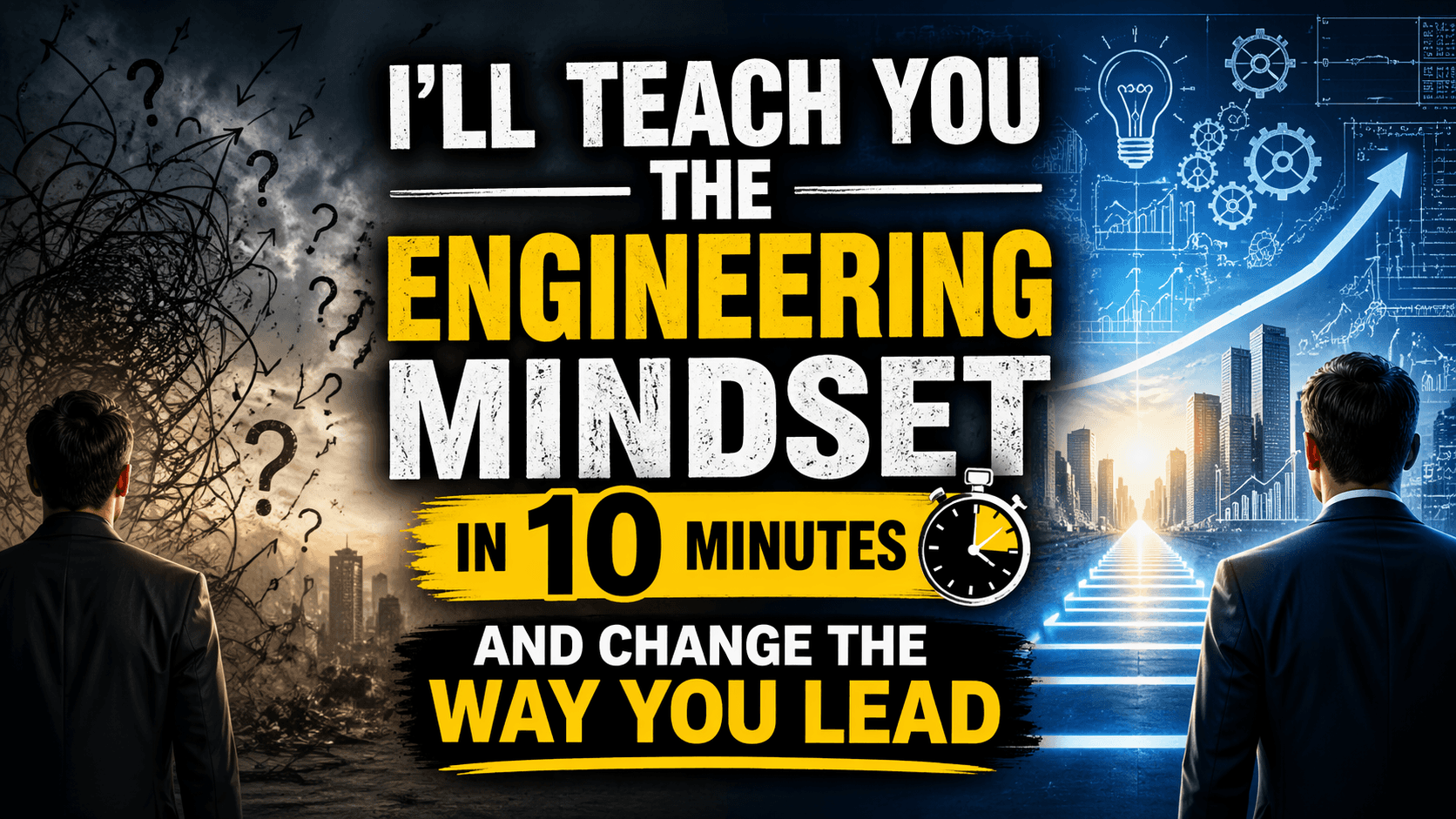
I’ll teach you the engineering mindset in 10 minutes; and change the way you lead
Leadership often feels unpredictable. But the engineering mindset gives you a way to bring structure to that uncertainty. To stop reacting and start designing. And that’s a big shift.
Most people think engineering is about calculations, drawings, and technical work.
It is, and it isn’t.
At the entry level it’s all about doing complicated looking mathematics. But the robots can do that now.
Engineers do something else.
Engineering is a way of thinking. And once you adopt that mindset, the way you manage and lead will change completely.
And you don’t need a 4 year degree to learn it.
Let’s break it down.
1. Build with Redundancy, Not Hope
Imagine a three-legged stool. A 100 kg person sits on it. How much weight should each leg carry?
Most people say 33 kg.
That’s wrong.
Each leg should be able to carry 100 kg.
Why? Because things fail. That’s reality.
Engineers design with a factor of safety. Leaders should do the same.
Don’t build teams, processes, or plans that only work when everything goes right. An engineer would say that is wildly risky. Build systems that still work when something goes wrong.
Because something always does.
Always, always, always add a factor of safety. Best case, you will over-deliver. Worst case, you will avoid under-delivering.
2. If It Doesn’t Scale, It Breaks
Engineers don’t design for today. They design for growth.
A road doesn’t just handle todays traffic. A pipeline must handle the needs of future generations too.
The same applies to leadership.
That quick fix you implemented? That manual process? That dependency on one key person?
It might work now. It won’t work later. That’s short term thinking. And just like replacing the pipeline later, it’s expensive thinking.
Always ask: Will this still work if things double?
If the answer is no, you’re building future problems. Future problems that you will need to solve. Future headaches.
👋 No more Powerpoint(!)
Have you heard of the Amazon 6 Pager Memo? It’s what Jeff Bezos uses to keep his mega-company productive. But it works so well that I use it for project management. Thousands of others do too. If you want my personal Amazon 6 Pager Memo template you can find it here.
3. Break Problems Down to First Principles
When engineers face a complex problem, they don’t guess.
They break it down into the smallest parts.
What are the inputs? What are the constraints? What actually needs to happen? What are the assumptions that might be wrong?
That last one is a big one. Read it again.
This is called first principles thinking.
As a leader, this stops you from solving the wrong problem. It forces clarity of thought.
Next time you are faced with a problem, I want you to try and understand the smallest pieces. If you can understand the small pieces, you can rebuild the whole system.
4. Pattern Recognition Is a Superpower
To be a top performer you need to solve uncommon problems which nobody has seen before. But engineers recognise that even in the uncommon, there are patterns that repeat.
Engineers notice signals others miss. And they have studied the input-output chain of events. They know what happens when the domino falls.
And now that they know what is going to happen, the seemingly uncommon problem becomes much easier to solve.
To get this power, pay attention to cause-and-effect in all things.
The more you pay attention, the better you get.
The more you are able to make the complex, simple.
5. Think in Frameworks
framework /ˈfreɪmwəːk/
A framework is a real or conceptual,, supporting structure—a set of rules, ideas, or beliefs—used to guide the development, planning, or organization of something.
Engineers rely on frameworks and processes.
Not just because they love structure (but actually we do), but because structure reduces mistakes.
As a leader, frameworks give you consistency.
How do you run meetings? How do you make decisions? How do you track progress?
If you don’t define these, you create confusion. This wastes time. Every meeting is different, every report is different, every day is different.
You can see how tiring this is. How mentally demanding. How it makes you and your team feel overwhelmed and close to burn-out.
Create frameworks up-front and stick to them. Change them very seldom.
It’s a ton of work but I promise you will be happy you did.
Final Thought
Leadership often feels unpredictable.
But the engineering mindset gives you a way to bring structure to that uncertainty. To stop reacting and start designing.
And that’s a big shift.
You go from managing problems to building systems that prevent them.
Bonus: Data First, Judgement Second.
Avoid using judgement immediately. You might think you know what to do. But pause.
Start with and examination of the data. Then apply judgement.
Not the other way around.
When you do this, your decisions become both rational and human.