ARTICLE DRAWING / CMS DETAIL
Published in Career Advice

Courtney
The Effective Project Manager
Proof of work replaced the resume. Here’s the simple way to actually show it.
The resume has changed.
Dan Koe talks about “proof-of-work” being the new resume. And some of the biggest names in leadership agree with him.
The CEO of Ramp, Eric Glyman, said it best: "I'm far more interested in proof of work." Not the resume. The proof.
Shane Mac says the same thing in fewer words: "Show us what you've built."
That's it.
Elon Musk has said this for years too. He looks for "evidence of exceptional ability." Not a degree. Not a fancy title. Evidence.
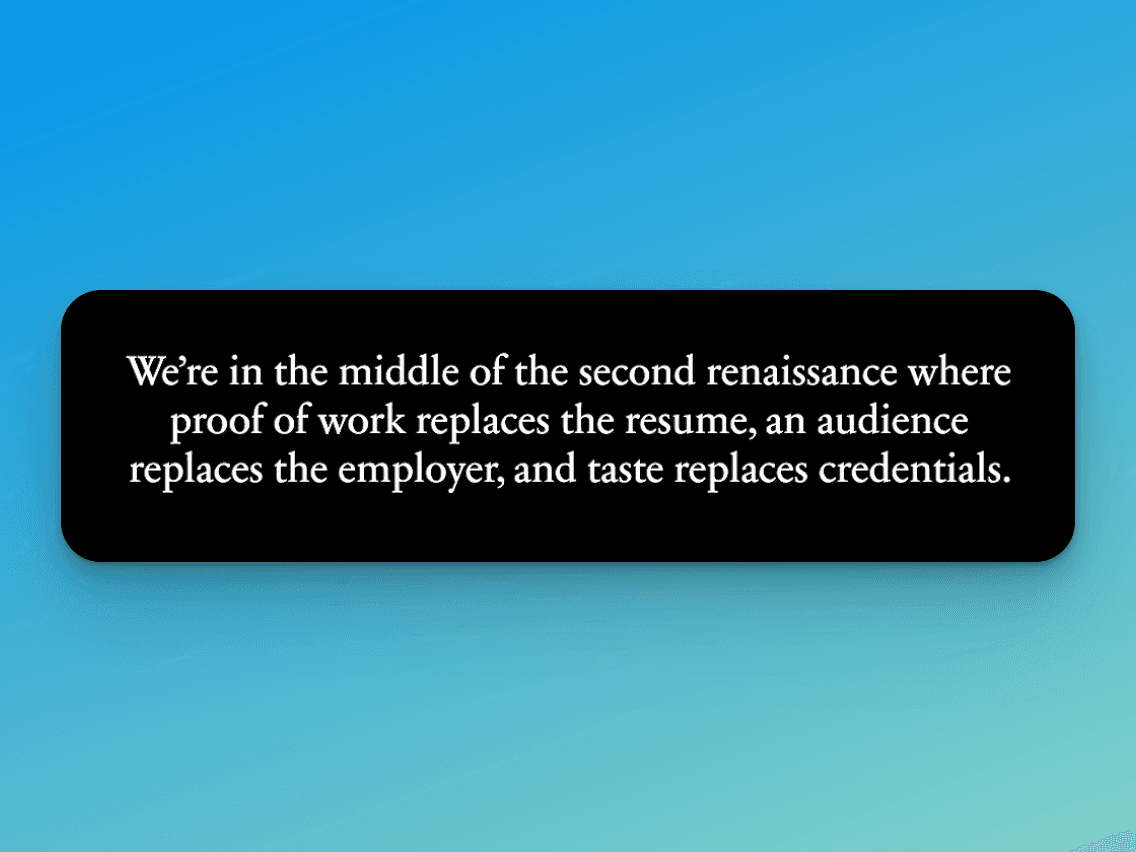
So here's what to do with your resume.
A resume is just a list. It tells people what you did.
It doesn't show them.
That's the problem. And that's why it’s changing.
There's a new thing now. It's called proof of work. It means you don't just say you did something. You show it. A write-up. A short video. A talk. Real proof.
Many big companies already think this way.
Google's Sergey Brin has said he likes hiring people who can figure things out. Not people who just know the right answers on a test.
I’d like to propose a phrase that you might not like, especially if you are a more formal, corporate individual.
Everyone should be a content creator.
I can feel your stomach turning as you read that. You’re thinking of an influencer. Or someone selling get-rich-quick courses.
But we’re not chasing likes. Or public praise. Or selling anything.
What we are doing, very simply, is becoming someone who shows their work instead of hiding it.
If you work in a niche field, like project management, you might only get ten people seeing your work. That's fine. You don't need a thousand strangers. You need the right ten people. A recruiter. A future boss. Someone in your industry who needed exactly what you wrote about.
And believe me, those people are watching.
Here's exactly what to do.
Start a simple list. Call it your brag list. Keep it on your phone or in a notebook.
Every week, write down one thing you did. This could be a hard choice you made. A problem you solved. Or a project that turned out well.
That's it. Just note it down.
Then, when inspiration strikes, add some detail to it. Write a short post (200 words). Or a longer piece (600 words). Or make a simple video (1-2min).
Then post it. On LinkedIn or Substack or on social media. Use your own account or make a new one. Just remember to use your real name.
Then do the most important thing: Don’t check it!
Ignore the urge to look for likes or comments or any sort of validation. Remember that this isn’t what its about. 99% of people who see it won’t engage in any way. Your friends won’t engage. Your family won’t engage. That’s completely normal.
If you're starting from zero, don't stress about posting all the time. Once a month is enough. Small and steady beats loud and rare. I promise you that as you start to enjoy it more, you will post more. Just build the habit.
One more thing. Don't perform. Document.
Performing means making your work sound bigger than it was. Documenting just means telling the truth about what happened. People can tell the difference. So can the person deciding whether to hire you.
Now turn your resume into a map.
Your resume shows people where they can find your deeper dives (your proof of work).
Don't throw your resume away.
Treat it like an index.
Instead of trying to say everything on one page, let it point outward. Add links. To the things you just created. To something you wrote. A video you made. A conference or internal talk you gave.
Your resume becomes the table of contents. Your real work becomes the proof.
The resume isn't going away.
It's just not enough on its own anymore.
👋 Want to find out where your skills actually fit?
I spent way too long digging through 5.8GB of O*NET data (the same database the U.S. Department of Labor uses to score every job in the country) so you don't have to. What came out the other side is the Skills Matrix, and it's the most useful career tool I've built.
It's not a "what's your personality color" quiz. It's a real matching engine covering 362 roles across 22 career neighbourhoods, scored against 58 plain-language skills, no jargon.
You get two things:
A printable PDF workbook. Tick your skills, answer 12 quick either/or questions, tally your matches by hand. No login, yours forever.
A companion web app that does the same thing instantly and shows you exactly which skills you're missing for each role you're eyeing.
If you've ever asked "where else could I take what I already do," this gives you an actual answer instead of a guess.