ARTICLE DRAWING / CMS DETAIL
Published in Careers

Courtney
The Effective Project Manager
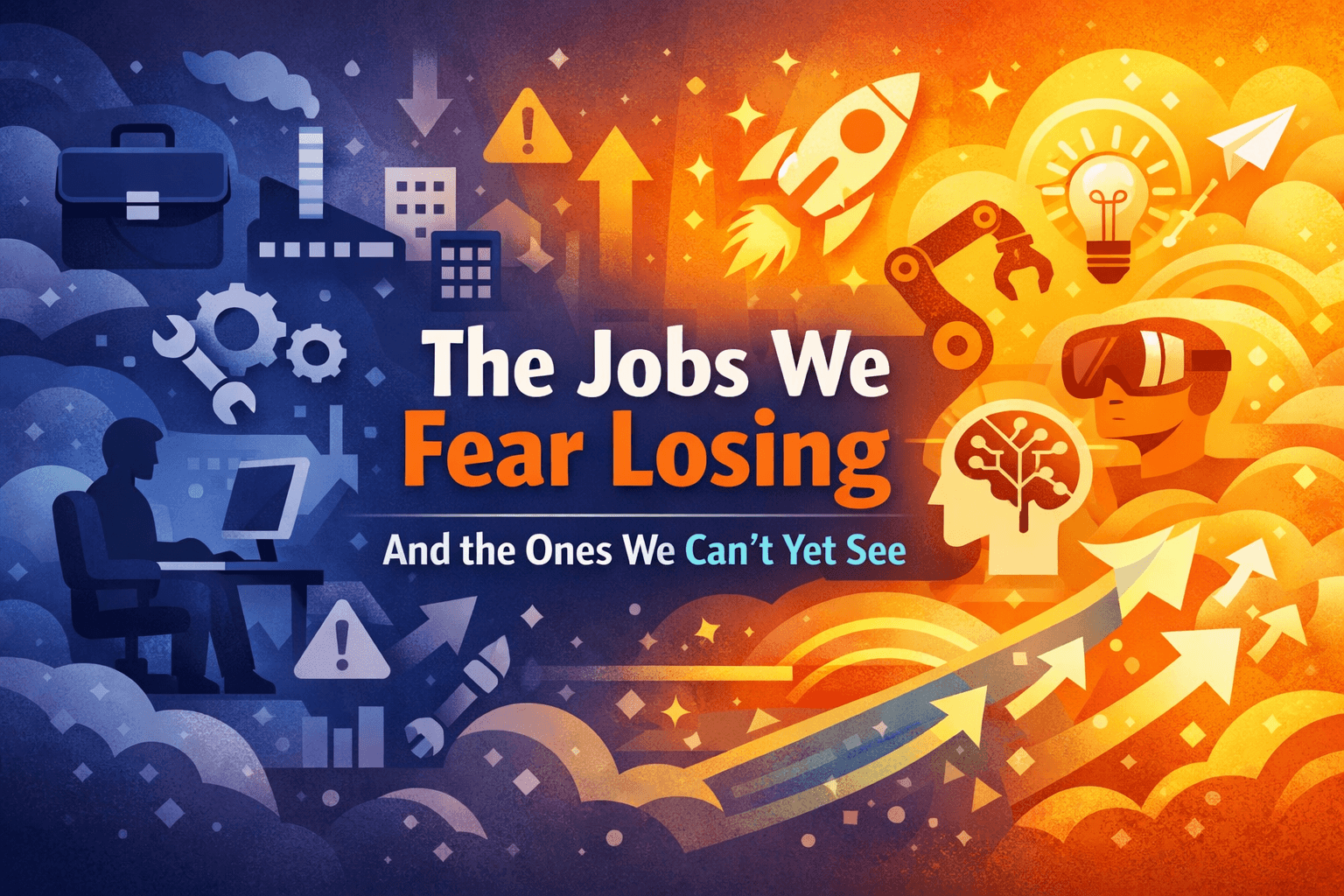
The Jobs We Fear Losing. And the Ones We Can’t Yet See
If history is any guide, the future won’t be defined by the jobs we lose. It will be defined by the ones we haven’t imagined yet.
In the 1960s and 70s, making a long-distance phone call wasn’t simple.
It required a person.
A real operator would sit at a switchboard, take a cable from one slot, plug it into another, and physically connect your call. It was skilled work. Stable work. Meaningful work. Nearly 800,000 people across America relied on these jobs to support their families.
Then came the electronic switch.
Overnight, the system changed. The need for human operators collapsed. Hundreds of thousands of jobs disappeared.
At the time, it looked like a catastrophe.
Communities lost employment. Families lost income. An entire profession vanished. If you were living through it, you wouldn’t be thinking about “innovation.” This was survival.
But something unexpected happened next.
As long-distance calling became cheaper (and eventually close to free) entirely new industries emerged.
Businesses could suddenly reach customers anywhere. Entrepreneurs could operate across states. The introduction of 1-800 numbers opened the door for a new kind of commerce.
And from that shift came something no one had predicted:
The call center.
Millions of jobs were created. Not despite the technological shift, but because of it.
The very innovation that destroyed one category of work became the foundation for another, much larger one.
And this pattern isn’t unique.
It has repeated itself throughout history.
The Industrial Revolution replaced manual labor but created factory jobs. Computers eliminated certain administrative roles but created entire industries in software, IT, and digital services. The internet disrupted traditional media but gave rise to creators, e-commerce businesses, and remote work.
Each time, the story feels the same in the moment:
Loss is visible.
Creation is invisible.
We can clearly see the jobs disappearing. We cannot yet see the jobs being formed.
That’s what makes moments like this (our current AI shift) feel so uncertain.
We focus on what AI might replace. Writers. Designers. Analysts. Developers. Entire categories of knowledge work.
And those concerns are valid.
But history suggests something important:
We are very good at predicting what will go away.
We are very bad at predicting what will emerge.
The opportunity is rarely where everyone is looking.
The real question isn’t just, “What jobs will AI take?”
It’s: What becomes possible when the cost of intelligence drops to near zero?
Because that’s what the electronic switch did for communication. It made connection cheap and accessible. And in doing so, it unlocked entirely new ways of working.
AI is doing the same for thinking, creating, and problem-solving.
New roles will appear. New industries will form. New types of businesses (ones that don’t make sense today) will become obvious in hindsight.
Some of them will employ millions of people.
We just can’t see them yet.
And that’s the point.
If history is any guide, the future won’t be defined by the jobs we lose.
It will be defined by the ones we haven’t imagined yet.
👋 No more Powerpoint(!)
Have you heard of the Amazon 6 Pager Memo? It’s what Jeff Bezos uses to keep his mega-company productive. But it works so well that I use it for project management. Thousands of others do too. If you want my personal Amazon 6 Pager Memo template you can find it here.