ARTICLE DRAWING / CMS DETAIL
Published in Leadership

Courtney
The Efffective Project Manager
Why is a one-on-one meeting so hard? And what can you do about it?
Most one-on-ones feel heavy because they're undefined. You aren’t sure what is going to happen and so you feel anxious.
Let's be honest. Most of us don't really like doing one-on-one meetings. I’m sure you don’t.
If you've ever put one off, kept it vague, or just gone through the motions, you're not alone. See if any of these sound familiar:
You don't like confrontation. Even when nothing is technically wrong, it can feel like something is about to go sideways.
It takes time. Not just the meeting itself, but the mental energy before and after.
Nobody trained you for this. You were good at your job, and then one day you were managing people. Nobody handed you a manual.
You don't always know the right thing to say. Especially in the moment, when someone says something unexpected and you have about three seconds to respond.
It exposes your blind spots. If you haven't been paying attention, they'll feel it. That's uncomfortable.
Emotions get involved. And once that happens, it's hard to know how to steer things back.
It takes confidence you don't always feel.
Most people reading this will tick at least three or four of those. And that's exactly why one-on-ones keep getting pushed back, kept short, or avoided altogether.
The problem usually isn't you, and it isn't them. These are all natural human feelings. We want to avoid conflict. Here are some ways I’ve found for making these awkward meetings just a little less cringe.
Start by reducing the pressure
Most one-on-ones feel heavy because they're undefined. You aren’t sure what is going to happen and so you feel anxious. Your brain fills in the blank with worst-case scenarios. Am I in trouble? Is this going to be a hard conversation? What are we even talking about?
Use the same four questions every single time:
What went well?
What's stuck?
What's next?
How can I help?
That's it. Now it's not a confrontation. Both of you know exactly how it’s going to go. Stress reduced.
👋 No more Powerpoint(!)
Have you heard of the Amazon 6 Pager Memo? It’s what Jeff Bezos uses to keep his mega-company productive. But it works so well that I use it for project management. Thousands of others do too. If you want my personal Amazon 6 Pager Memo template you can find it here.
Make it predictable
If you know its coming on a schedule, you aren’t worried that you’re being called in over something you did wrong.
Every two weeks is enough. Same day. Same time. Same format.
When people know what's coming, the anxiety drops and the conversation gets easier.
Consistency is the whole game here. A mediocre one-on-one that happens reliably is worth more than a perfect one that keeps getting rescheduled.
Keep it short
Thirty minutes is plenty. You are not trying to solve everything in one sitting. You are just keeping things moving, staying connected, and catching problems before they grow.
If you finish in twenty minutes, great. That's a win.
Prepare just a little
You don't need a full agenda for these. Before the meeting, write down three things:
👍 One thing they did well
⚠️ One thing they could improve
❓ One question you want to ask
That's enough to guide a short conversation without overthinking it. Walking in with even one specific observation shows the other person that you're paying attention. That builds trust and shows you are on their side. Which you are. Remember that.
Separate facts from feelings
Start with what's actually happening at work. Then, if it comes up, talk about how it feels.
This order matters. Jumping straight to emotions without grounding the conversation in facts tends to put people on the defensive.
Lead with what happened. Then explore why it matters.
Create a safe space, simply
You don't need a workshop or a framework for psychological safety. But you do need to do two things:
Don't interrupt.
Don't get defensive.
If someone is honest with you, especially about something uncomfortable, especially about something you’ve done wrong, acknowledge it. Say thank you. Make it worth it for them to have said something.
And accept that it might feel a little awkward sometimes. That's completely normal. It gets easier the more you do it.
Below, I’ve created a simple template to use in your next 1:1.
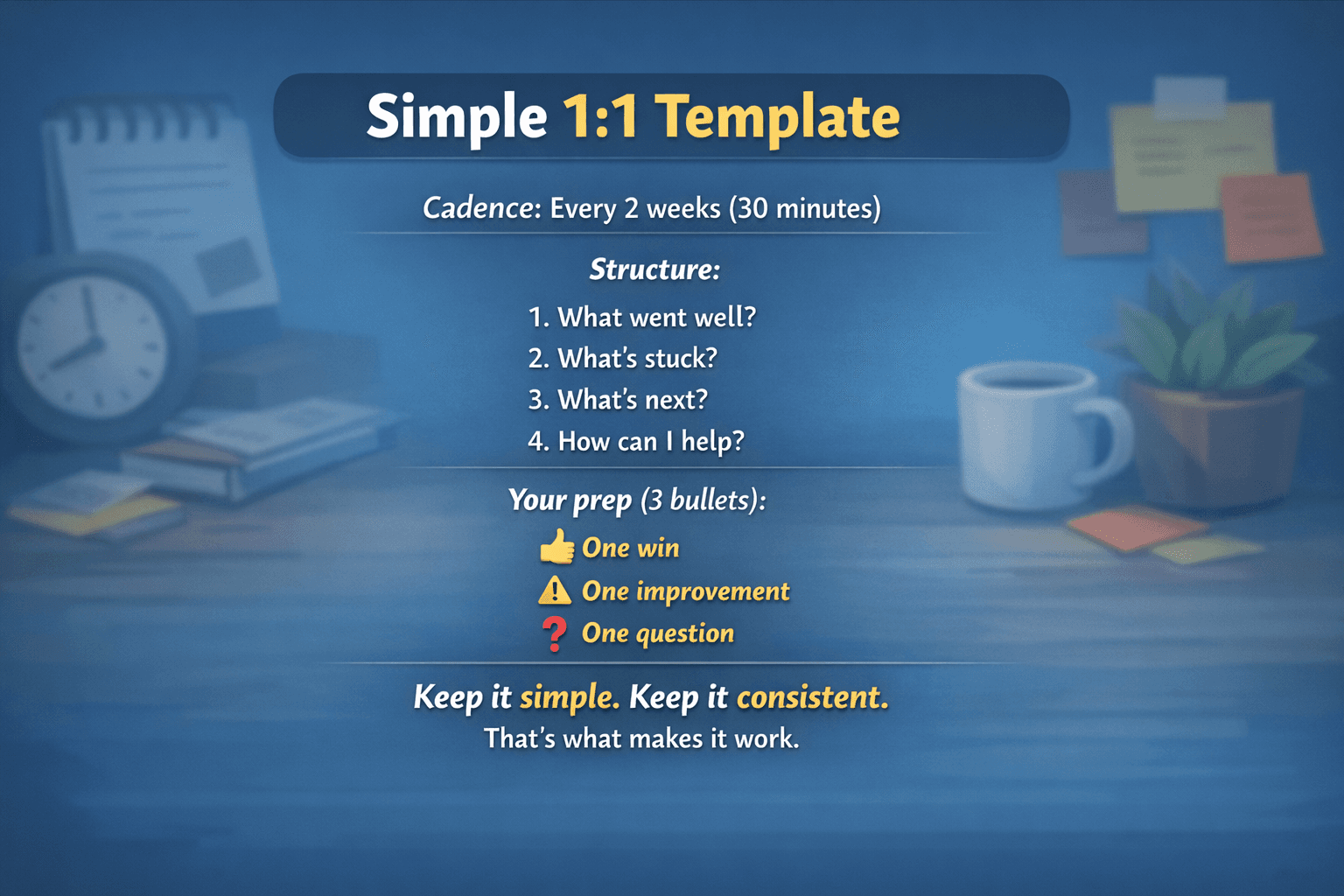
Simple 1:1 Template
Use this every time. Adapt it as you go.
Cadence: Every 2 weeks | 30 minutes
The four questions:
What went well?
What's stuck?
What's next?
How can I help?
Your prep (3 bullets, written before you walk in):
👍 One win to call out
⚠️ One thing to work on
❓ One question to ask
Keep it simple. Keep it consistent. That's what makes it work.
Wrap-Up
Now that you know why a one-on-one feels awkward, and how to make it less awkward, go ahead and schedule them. There are huge benefits. And they are far less tedious than those lengthy project meetings or the dreaded management pow-wow.